Stamped Concrete or Pavers: Which Fits Your Patio
Both can give you the look of stone or brick, and the real difference shows up in how each one holds up after the crew leaves.
October 16, 2026 · 4 min read
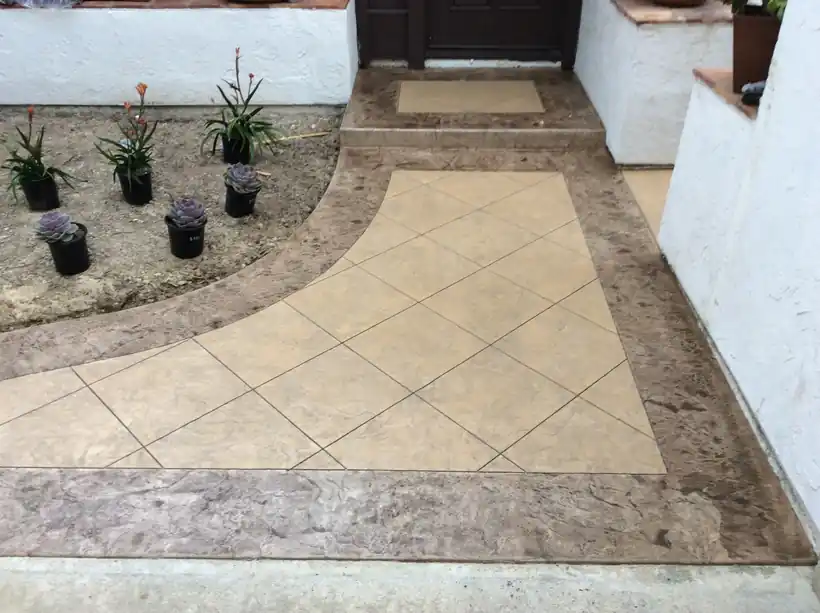
Plenty of homeowners start a patio or walkway project with a picture of stone or brick in mind. Natural stone and individual pavers can be beautiful, and they're one way to get there. Stamped concrete is the other. The two look similar from the street and behave quite differently up close, so it helps to understand what you're signing up for with each.
Two ways to reach the same look
Pavers are individual units, made of concrete, brick or stone, set one by one over a prepared base with the joints filled in between them. Stamped concrete is poured as a single slab. While the surface is still workable, the crew presses patterns into it with stamping mats and tools, so the finished slab reads as stone, brick, slate or tile. Colour is added through the mix or on the surface, and the whole thing is sealed once it has cured.
That difference, many pieces against one piece, explains most of what follows.
What stamped concrete gets you
Albert Cruz Jr., a licensed concrete contractor in San Marcos, lists the perks of stamped concrete in his FAQ, and they match how the material actually works.
- The look of stone or brick for less than the real thing, which is how Albert puts it. A patterned slab gives you the character of interlocking stone without every piece being cut, placed and set by hand.
- One solid surface. There are no joints to fill, so there are no weeds pushing up between pieces and no individual stones working loose or drifting out of line.
- Easy cleaning. A sealed, continuous surface sweeps and hoses off, and grit has no sand joints to hide in.
- Custom colours and patterns. Terracotta, warm sand, charcoal or slate grey, with borders and medallions to set off the main field.
Where pavers still make sense
Pavers earn their place in some situations, and a fair comparison says so. Because each unit sits on its own, you can lift a section and reset it. If a utility line needs access under the patio, or one area settles, a paver surface can be taken up and put back. A concrete slab has to be cut and patched, and a patch rarely disappears completely.
Pavers can also flex a little with ground movement where a rigid slab would crack. That only holds when the base is well compacted. On a poor base, pavers shift, sink and wave, which is where the weeds and uneven edges people complain about come from.
Concrete cracks. It's what the material does, and a good contractor plans for it with control joints, the grooves tooled or sawn into the slab so any movement shows up along a straight, intentional line. On a stamped patio those joints are often laid out to follow the pattern, so they barely register.
Choosing colour and pattern
This is where stamped concrete is the most fun, and where a little restraint pays off. Patterns run from irregular flagstone and slate to running-bond brick and cobble. Colour can be a single tone across the slab, or layered so it reads like natural material with some variation in it.
Many of the stamped entries and patios Albert's crew has finished feature a dark border band around a lighter field. The band frames the work, gives the pattern a clean edge and separates the hard surface from the lawn or planting beside it. Look at colour samples outdoors, in the light your patio will actually get, before you decide. A swatch under a kitchen light tells you very little.
Preparation and sealing decide how it ages
Whichever you choose, the ground under it does the heavy lifting. Concrete needs a compacted base, sensible drainage and reinforcement suited to the job. Pavers need that same compacted base plus tight edge restraints. Skimp on that work and either surface will disappoint you.
Stamped concrete finishes with a sealer, which protects the colour, makes the surface easier to wipe clean and is meant to be renewed. Albert's maintenance advice is short: keep it clean, fill small cracks and reseal every few years. His sealers are non-toxic and eco-friendly, safe for pets and landscaping, which is worth checking with any contractor if there's a dog or a vegetable bed next to the patio.
Questions to ask before you decide
- How will the base be prepared and compacted?
- Where will the control joints go, and will they follow the pattern?
- Which sealer will be used, and when will it need renewing?
- How will water drain off the patio and away from the house?
- Can I see finished work in person, not just photos?
If you're comparing stamped concrete with pavers for a patio, walkway or entry, call Albert Cruz Jr Concrete at (760) 716-4142 for a free estimate. Albert has held his California concrete contractor license since 1990, and his approach is a plan built around your property rather than one package for everybody.
Albert Cruz Jr Concrete, (760) 716-4142
Call (760) 716-4142More articles
Concrete or Asphalt for a North County Driveway
Both materials can work, but they age differently under San Diego County sun, and the surface is only half of the job.
Pool Deck Concrete That Feels Good and Stays Safe Underfoot
A pool deck takes wet feet, hard sun and constant splashing, so the surface has to do more than look good.